
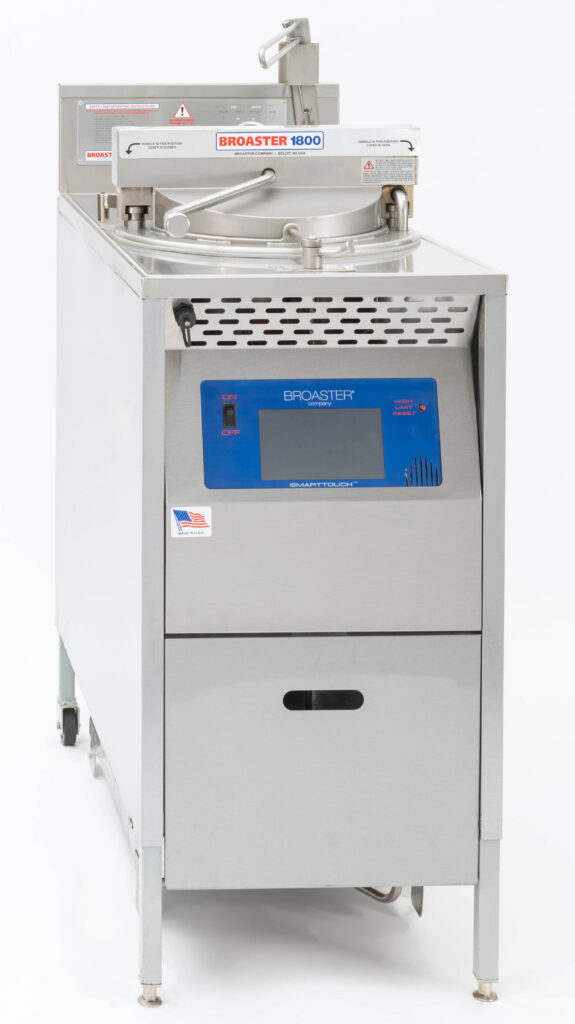
Choosing a commercial pressure fryer is one of the larger capital decisions you will make for your kitchen. The right unit pays for itself through faster cook times, lower oil consumption, and a finished product your customers keep coming back for. The wrong one ties up capital and floor space without delivering the throughput or consistency your operation demands.
This guide walks you through the criteria that matter most when comparing pressure fryers: capacity, energy efficiency, safety systems, and cooking performance. By the end, you will have a clear framework for matching a fryer to the specific needs of your menu and your volume.
Key Takeaways:
- Capacity should be matched to your peak-hour demand, not your average daily volume, to avoid bottlenecks during rushes.
- Energy efficiency directly affects operating costs, so compare heavy-load cooking efficiency and idle energy rates between models.
- A triple-redundant safety system, including a relief valve, splash guard, and pressure-activated cover lock, protects staff and equipment.
- Round cooking wells distribute heat more uniformly than rectangular designs, reducing cold spots and improving finished product consistency.
- Broaster pressure fryers combine built-in oil filtration, Auto-Comp cook time adjustment, and a 10-year cooking well warranty.
What is a Commercial Pressure Fryer?
A commercial pressure fryer is a sealed cooking appliance that fries food under controlled pressure, typically operating between 12 and 14 psi. The sealed environment traps steam released by the food, raising the internal pressure and allowing the oil to cook at lower temperatures than a standard open fryer.
This mechanism does two things at once. It speeds up cook time because the pressurized steam transfers heat more efficiently. And it reduces oil absorption because the sealed lid prevents moisture from escaping the food as quickly. The result is a finished product that retains more of its natural juices and seasonings.
How Does Capacity Affect your Pressure Fryer Decision?
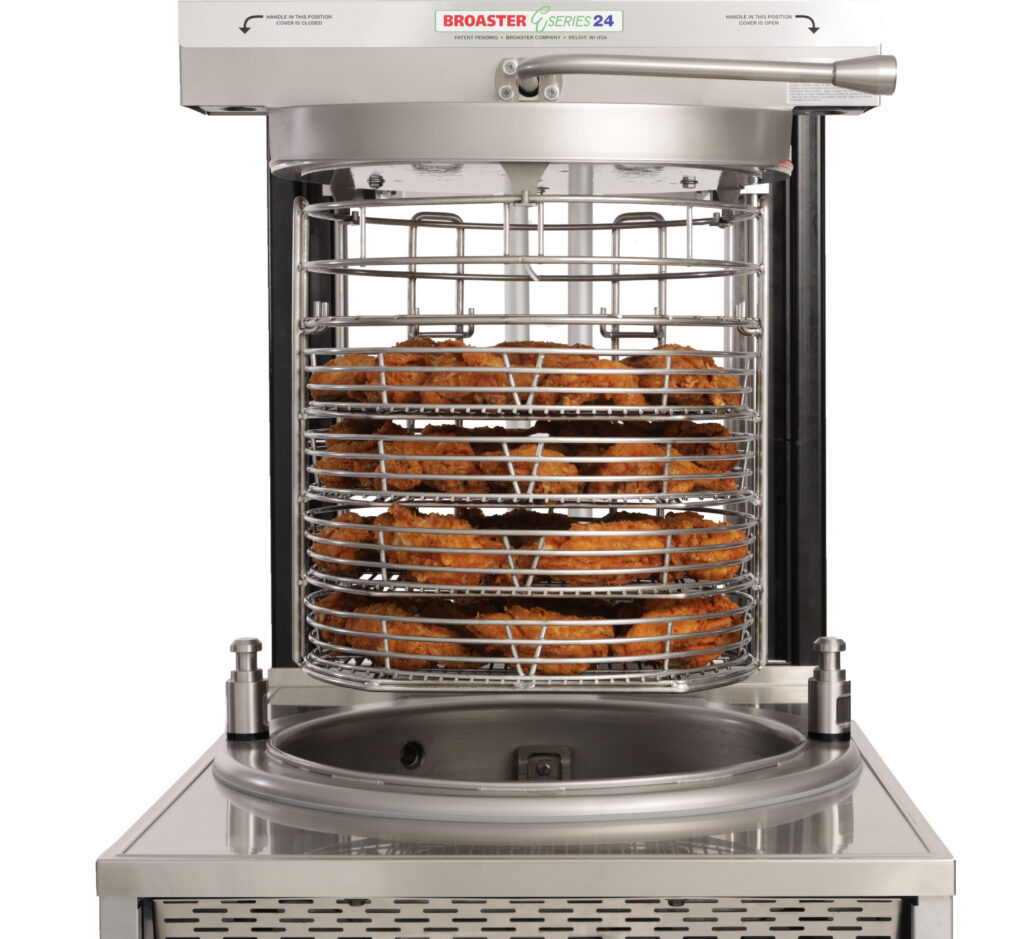
Capacity is the first filter for any equipment purchase. If your fryer cannot keep up with peak-hour demand, you lose sales. If it is oversized for your actual volume, you pay more for oil, energy, and floor space than you need to.
Most pressure fryers are rated by the number of bone-in chicken pieces per load. Entry-level units handle roughly 16 pieces per cycle. Mid-range models cook 32 pieces. High-volume units, like the Broaster 2400, can produce 48 to 64 pieces in as little as 11 minutes per cycle.
To size your fryer correctly, calculate how many servings you need during your busiest hour, then divide by the cook time per load. That gives you the minimum number of cycles required and tells you whether a single unit or multiple smaller units fits your workflow better.
Why Energy Efficiency Matters for Pressure Fryer Operating Costs
Energy is a recurring cost that compounds over thousands of cook cycles each year. Two fryers with identical capacity can have very different energy profiles depending on their heating elements, insulation, and idle energy rates.
According to the ENERGY STAR commercial fryer criteria, standard electric fryers should achieve at least 83% heavy-load cooking energy efficiency with an idle rate at or below 800 watts. Gas units should reach at least 50% efficiency with idle rates no higher than 9,000 Btu/hr.
Pressure fryers tend to perform well against these benchmarks because the sealed cooking environment retains heat that open fryers lose through evaporation. Faster cook times also mean the heating elements cycle less frequently, further reducing per-batch energy draw. The Broaster E-Series 24 reports up to 35% gas energy savings compared to previous-generation models.
What Safety Features Should a Pressure Fryer Include?
Pressure fryers operate with hot oil under pressure, so safety systems are not optional. When evaluating units, look for three layers of protection at minimum: a pressure relief valve, a splash guard, and a pressure-activated cover locking mechanism.
A relief valve prevents over-pressurization by venting excess steam if pressure exceeds the set limit. A splash guard catches any oil or steam that escapes during the venting process. A pressure-activated cover lock ensures the lid cannot be opened while the cooking well is pressurized, protecting your staff from burns.
Beyond these basics, useful additions include a drain valve interlock that prevents accidental oil draining during a cook cycle, a resettable high-temperature limit switch, and a built-in fire suppression system that complies with NFPA 17A standards. Broaster pressure fryers include a triple-redundant safety system as standard equipment across every model in the lineup.
How Cooking Well Design Affects Finished Product Quality
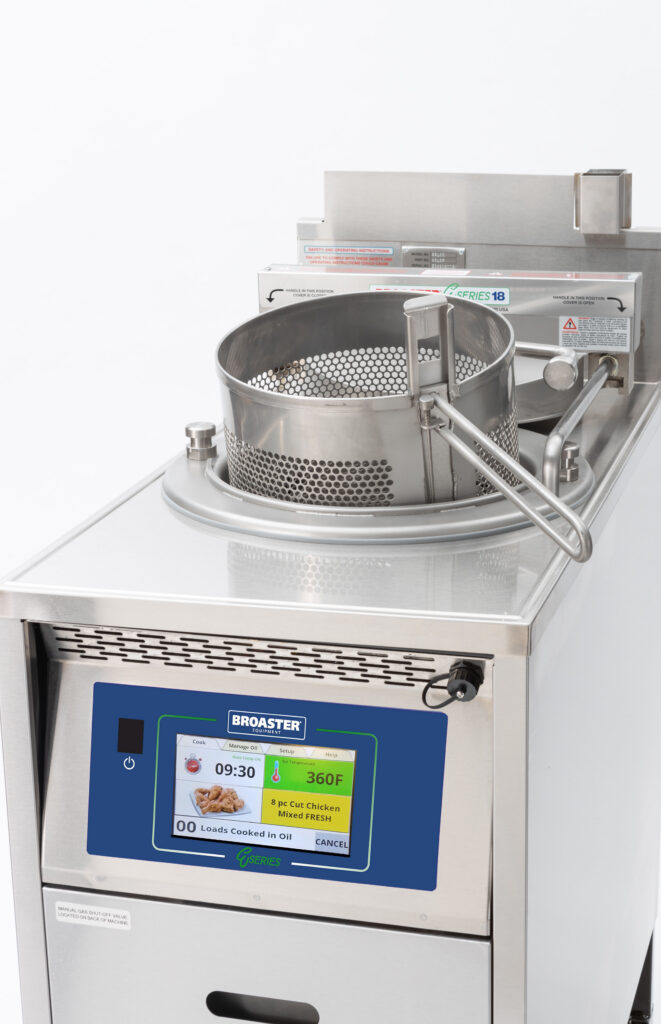
The shape of the cooking well has a direct effect on how evenly your food cooks. Rectangular wells concentrate heat unevenly, creating cold spots in the corners where food can come out underdone. Round cooking wells eliminate those corners entirely, allowing heat to distribute uniformly across the entire cooking surface.
Uniform heat distribution means every piece in the batch reaches the same internal temperature at roughly the same time. For operators running bone-in chicken, that consistency translates into fewer quality complaints and less product waste from undercooked or overcooked pieces.
Broaster Pressure Fryers use a round cooking well design across every model. This engineering choice is a core reason the equipment produces a consistent finished product batch after batch, without requiring your staff to rotate or rearrange pieces mid-cycle.
How Built-In Oil Filtration Extends Oil Life & Cuts Costs
Oil is one of the highest recurring costs in any frying operation. The longer you can safely extend oil life, the more money stays on your bottom line. Built-in oil filtration systems remove food particles and carbon deposits between cook cycles, slowing the chemical breakdown that degrades oil quality.
Some fryers require a separate, standalone filtration unit. That means additional floor space, an extra piece of equipment to maintain, and a manual step your staff has to remember during busy shifts. Fryers with integrated filtration remove that variable entirely by filtering oil automatically as part of the standard cook-and-drain sequence.
Broaster Company includes on-board oil filtration as standard on all pressure fryer models. The E-Series extends this further with automatic oil filtration between cook cycles, on-board oil replenishment, and bulk oil handling capabilities. These features can extend useful oil life up to four times longer than units without integrated filtration.
What Role Does Cook Time Play in Throughput & Labor?
Shorter cook times translate directly into higher throughput per hour. In a pressure fryer operating at 12 to 14 psi, eight pieces of bone-in chicken can cook in 10 to 12 minutes. The same batch in an open fryer typically takes 16 to 18 minutes. That difference adds up quickly during a lunch or dinner rush.
Faster cycles also reduce the total labor minutes your staff spends managing the fryer. Features like auto-lift systems on the ESeries-24 and SmartTouch controllers simplify operation further, allowing less experienced kitchen staff to run the equipment without hands-on supervision for every batch.
How to Compare Pressure Fryers: A Practical Checklist
When you are evaluating specific models side by side, use these criteria to structure your comparison:
- Pieces per load: Match this to your peak-hour serving projections.
- Cook time per cycle: Shorter cycles mean more batches per hour.
- Oil capacity: Lower oil-to-food ratios reduce ongoing oil costs.
- Energy rating per batch: Request manufacturer data on heavy-load efficiency and idle rates.
- Safety certifications: Confirm the unit includes a pressure relief valve, splash guard, cover lock, and drain interlock at minimum.
- Filtration system: Built-in filtration reduces labor and extends oil life.
- Cooking well shape: Round wells distribute heat more uniformly than rectangular designs.
- Footprint and hood space: Measure your available space before committing. Some units require as little as 16 inches of hood width.
- Warranty terms: Look at cooking well warranty duration specifically, since it is the most expensive component to replace.
- Controller features: Programmable cook profiles, auto-temperature compensation, and touchscreen interfaces reduce training time and operator error.
Open Frying vs. Pressure Frying: Understanding the Trade-Offs
Open frying and pressure frying have each been used in commercial kitchens for decades. Both get the job done, but in different ways. Understanding where each method has an advantage helps you make a decision based on your specific menu and customer expectations.
Open fryers do tend to produce a crunchier exterior texture. If maximum crunch is the defining characteristic your customers expect, and your menu is built around items like french fries or extra-crispy tenders, an open fryer may suit that specific application.
Pressure frying, on the other hand, excels at retaining moisture and sealing in seasonings. For bone-in chicken and other proteins where juiciness, flavor retention, and uniform doneness are the priority, a pressure fryer delivers a noticeably different finished product. It also cooks faster, uses less oil per batch, and extends oil life, all of which affect your cost of ownership over time.
How Branded Food Programs Add Value Beyond the Equipment
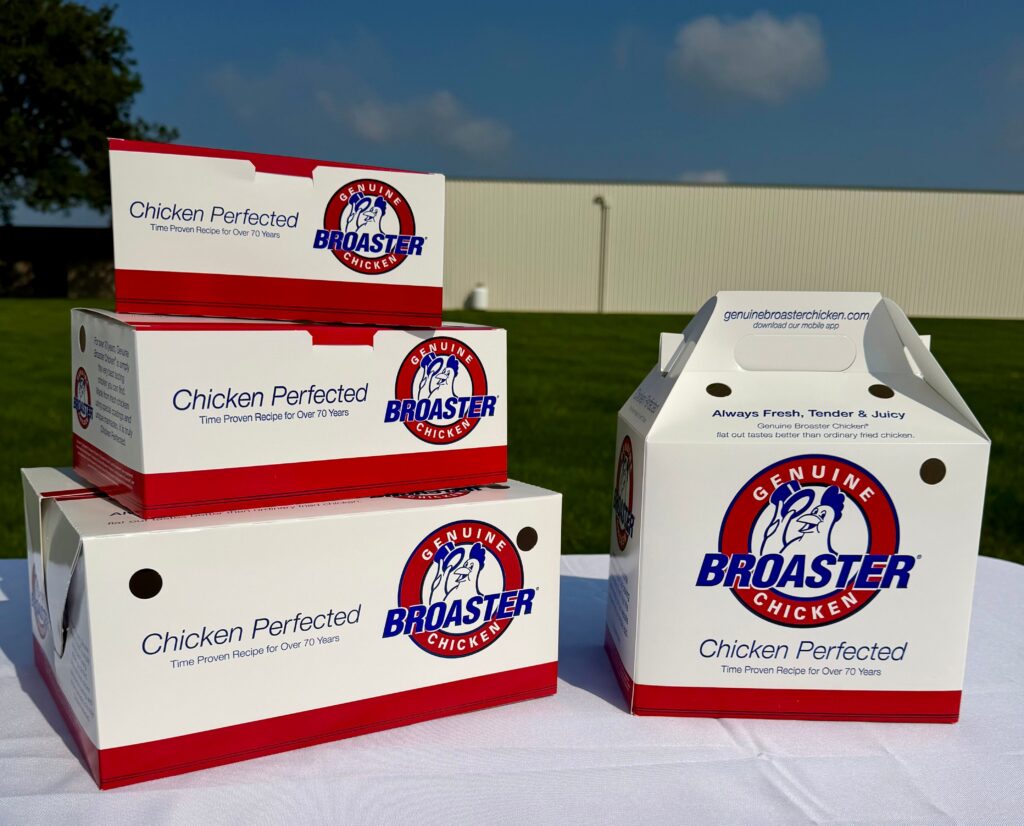
A pressure fryer is only part of the equation. What you cook in it, and how you market it, determines whether the investment generates strong returns.
Broaster Company pairs its equipment with complete trademark food programs, including proprietary marinades, coatings, and seasonings developed specifically for pressure frying. Operators who join the Genuine Broaster Chicken trademark program receive branded packaging, on-site training, and marketing support with no royalties. You keep all the profits while benefiting from a nationally recognized brand name.
For locations with limited kitchen space or staff, the Broaster Express trademark program offers pre-marinated frozen foods designed for ventless fryers. This combination lets you add a high-margin food program without installing a traditional hood system.
Choosing the Right Pressure Fryer for Your Operation
The right pressure fryer for your kitchen depends on your volume, your menu, and your available space. Start by calculating your peak-hour demand in servings. Then narrow your options by matching capacity, energy efficiency, and safety features to the specific requirements of your operation.
If consistency, oil savings, cook speed, and long-term cost of ownership are the criteria that matter most to your business, pressure frying is a proven method. And if you want a complete solution that pairs equipment with branded food programs and operational support, Broaster Company’s ventless solutions and full-size pressure fryer lineup are built for exactly that purpose.
FAQ’s About Choosing a Commercial Pressure Fryer
How long does a commercial pressure fryer take to cook chicken?
Most commercial pressure fryers cook bone-in chicken in 10 to 12 minutes per load at 12 to 14 psi. This is roughly 30 to 40% faster than open frying the same batch. Broaster Pressure Fryers include Auto-Comp technology that automatically adjusts cook time based on load size and temperature.
Do pressure fryers require a hood system?
Full-size pressure fryers typically require a hood system, though they often need less hood space than open fryers. Broaster Company also offers ventless hood systems, which allows operation with a movable hood.
What is the advantage of a round cooking well?
A round cooking well eliminates the cold spots that form in the corners of rectangular designs. Heat distributes uniformly across the entire surface, producing a consistent finished product in every batch. Broaster’s round well design reduces sticking and simplifies cleaning.
How does built-in oil filtration save money?
Built-in filtration removes food particles and carbon between cook cycles, slowing oil degradation. This extends oil life, which reduces oil purchase frequency and lowers your per-batch operating costs. Broaster Company includes integrated filtration on every pressure fryer model.
Can I run a branded food program without ongoing fees?
Yes. Broaster Company’s Genuine Broaster Chicken trademark program and Broaster Express trademark program include branded packaging, training, and marketing support with no royalties. Operators retain their own identity and keep all profits.